Knowledge systems
How AI Connects Entities, Topics, and Relationships
8 min read · Reviewed August 06, 2026
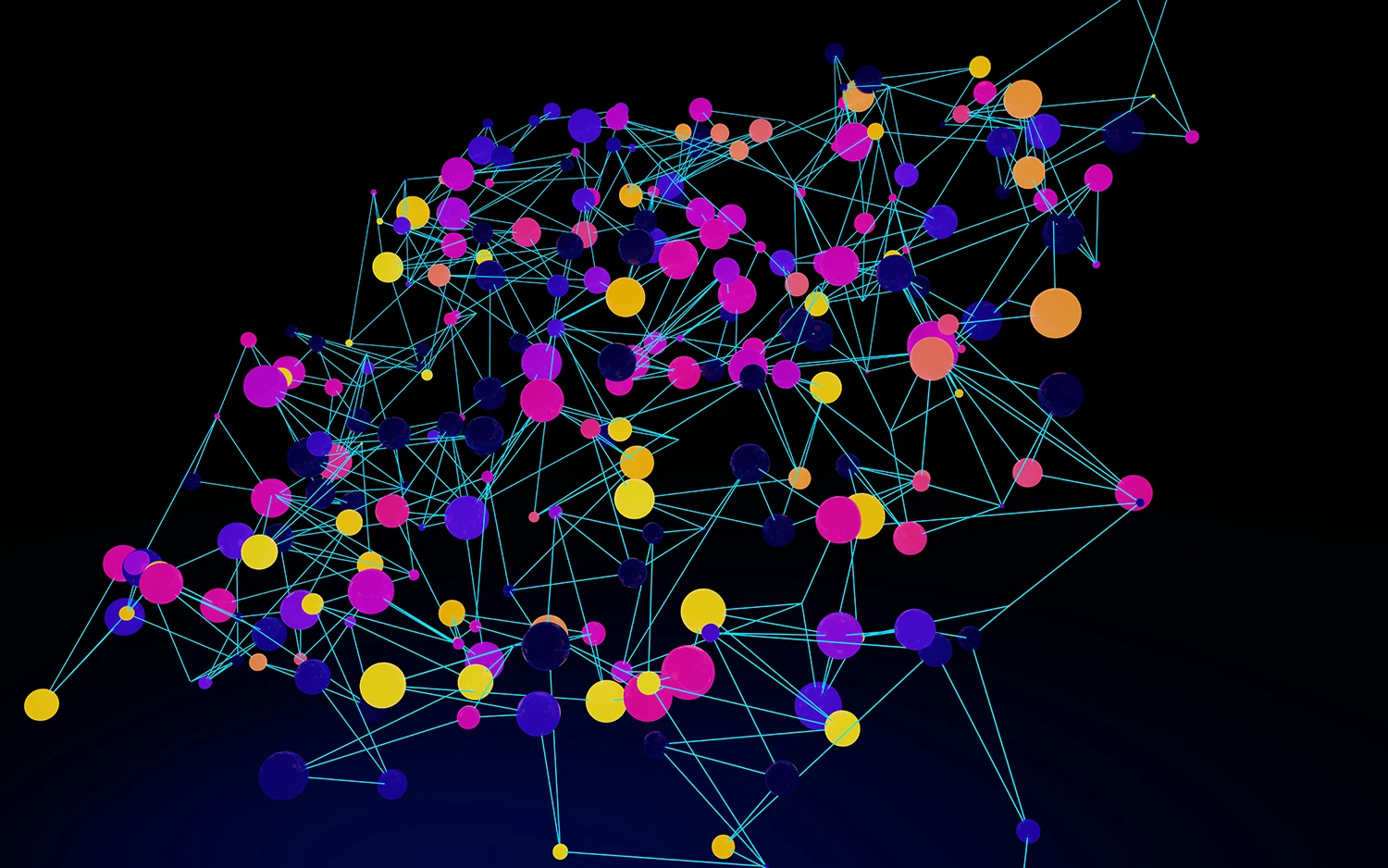
A knowledge graph represents information as entities and the relationships between them. Instead of treating facts as isolated rows or passages, it connects people, organizations, places, products, concepts, and events in a network that can be queried and traversed.
A knowledge graph might represent “Claude” as a product, connect it to “Anthropic” through a developed-by relationship, and connect Anthropic to locations, people, models, and documentation. Those explicit relationships help systems answer questions that require identity, context, and multi-step connections, and increasingly they help answer engines decide which brand or source to name in a generated answer.
From strings to things
The idea has a clear origin worth knowing, because it explains why entities matter so much to modern answers. When Google introduced its Knowledge Graph in 2012, it framed the shift with a memorable phrase: things, not strings. Traditional search matched the characters in your query against the characters on a page. A knowledge graph instead tries to understand the real-world thing a query refers to, and everything connected to it. That is the leap from treating "jaguar" as a five-letter string to recognizing that it might mean an animal, a car brand, or a sports team, and choosing based on context.
This matters for AEO because generated answers inherit that entity-first view. When an answer engine decides whether to mention your brand, it is not matching a keyword; it is asking whether it recognizes you as a distinct, trustworthy thing in the world, and what it knows about your relationships to other things. Understanding the graph, then, is understanding the layer at which that recognition happens.
The basic structure
Knowledge graphs are commonly described using nodes, edges, and properties. A node represents an entity. An edge represents a relationship. Properties add attributes such as a date, identifier, description, or status. The power comes not from any single fact but from the connections: once entities are linked, a system can traverse from one to another to answer questions no single document states outright.
The exact data model varies. Property graphs store properties directly on nodes and relationships, and this is the model Google's own enterprise knowledge graph uses, mapping data into entity properties and creating relationships by linking identifiers. RDF-based graphs, standardized by the W3C, express facts as subject-predicate-object triples and often use formal vocabularies or ontologies. Both models capture the same essential idea; they differ in how strictly the structure is defined and how the data is queried.
Why entity identity matters
Words can be ambiguous. A knowledge graph attempts to resolve a mention to a specific entity. “Apple” might mean a fruit or a company. Once identity is resolved, the system can use the correct relationships and attributes, and, just as importantly, avoid attaching the wrong ones.
Stable identifiers are what make this reliable. Names change and multiple entities can share similar names, so graphs assign each entity a durable identifier that does not depend on its label. Google's systems, for instance, assign a stable machine identifier to each entity cluster so that data from different sources can be reconciled to the same underlying thing. For a publisher, the practical implication is that consistency of naming and clear association with known identifiers, your own official profiles, your Wikidata entry, your verified social accounts, is how you help a graph resolve you correctly rather than confusing you with something else.
Where the facts come from
A common misconception is that a knowledge graph invents or ranks facts. It compiles them. Google states plainly that the facts in its Knowledge Graph come from a variety of sources: public sources that compile factual information, licensed data for things like sports scores and stock prices, and information supplied directly by content owners, including those who claim and suggest changes to their knowledge panels. Google is also explicit that inclusion is not automatic or guaranteed; its stated goal is to surface publicly known, factual information when its systems determine that doing so is useful.
Two consequences follow for anyone hoping to be represented accurately. First, the graph reflects what is consistently stated about you across trusted sources, so contradictory or thin information across the web produces a weak or wrong entity. Second, content owners have some direct influence, claiming a knowledge panel and suggesting corrections, but that influence sits on top of the broader web consensus rather than replacing it. You are, in effect, one voice among the sources that describe you, and consistency across those sources is what earns confidence.
Knowledge graphs in search and AI
Entity understanding
Disambiguate names and connect mentions to known entities.
Relationship queries
Answer questions involving ownership, location, membership, sequence, or dependency.
Data integration
Connect facts from documents, databases, APIs, and organizational systems.
Grounding
Provide structured facts or graph neighborhoods to an AI application.
Google has long documented the use of a Knowledge Graph in Search to understand entities and facts, and it now describes that same graph as feeding its AI experiences: its enterprise knowledge graph is used to improve entity recognition, relationship mapping, and intent understanding for Gemini. Current enterprise systems from Google, Microsoft, and other vendors also use graph structures to ground AI applications in connected organizational data, so that a generated answer can rest on explicit, checkable relationships rather than on pattern-matching alone.
How answer engines use entities
It helps to be concrete about where the graph actually touches a generated answer. Three moments stand out, and each one is a place where being a clearly-defined entity works in your favor.
Disambiguation
Before answering, the system decides which "thing" the query is about. A well-defined entity is easier to select correctly and less likely to be confused with a similarly-named one.
Grounding and verification
Entities give the model checkable facts to lean on. An answer about your product can be anchored to known attributes rather than reconstructed from loose text.
Attribution
When an engine names a brand, product, or source, it is naming an entity it recognizes. If you are not a distinct entity in its understanding, you are hard to cite by name.
This is the throughline that connects knowledge graphs to AEO directly. Retrieval decides which passages a model reads; entities decide who and what those passages are understood to be about, and therefore who gets named. A page can be retrieved and still fail to earn a mention because the system cannot confidently tie it to a recognized entity. Clarity about identity is not a nicety here; it is a precondition for attribution.
Knowledge graphs and vector search
Knowledge graphs and vector search are often discussed together, but they solve genuinely different problems, and the strongest systems use both. Vector search excels at finding content that is semantically similar to a query even when the words differ. A knowledge graph excels at following explicit, named relationships that similarity alone would miss. Ask "which products does this company make, and what does each support," and similarity search will surface pages that sound relevant, while a graph can actually traverse the company-to-product-to-feature links and return the structured answer.
| Method | Best at | Example |
|---|---|---|
| Vector search | Finding semantically similar content | Retrieve passages about apparel mockup workflows |
| Knowledge graph | Following explicit entities and relationships | Find products made by a company and the features each product supports |
| Combined retrieval | Using semantic recall plus structured relationships | Find relevant documents, then expand through linked entities |
What is GraphRAG?
GraphRAG is a broad label for retrieval approaches that use graph structures to provide context to a generative model. Implementations vary. A system might retrieve a neighborhood around an entity, traverse relationships, summarize communities in a graph, or combine graph queries with vector search. The common thread is that structure, not just similarity, shapes what context the model sees.
It should not be treated as one standardized architecture or as a replacement for every other form of retrieval. It is a family of techniques, useful precisely when a question depends on relationships between entities rather than on the wording of any single passage.
Making your brand legible as an entity
You cannot edit a platform's knowledge graph directly, but you can make yourself far easier to recognize, resolve, and describe correctly. The goal is to remove ambiguity: give the systems clear, consistent, corroborated signals about who you are and how you relate to other known things.
State your identity explicitly
Use Organization structured data to name your entity in machine-readable form. Google recommends properties useful to users, such as name (and alternateName), an indication of real-world presence like address, and online presence like url and logo.
Link to your other profiles
The sameAs property lets you point to your authoritative profiles elsewhere. Listing your official social, Wikipedia, or Wikidata URLs tells a system that all of them describe the same entity, which aids disambiguation.
Two honest caveats keep this in proportion. First, structured data describes; it does not decree. Google is explicit that there are no required Organization properties and that markup should reflect information genuinely useful to users, not manufactured signals, and misused markup can trigger a manual action that causes it to be ignored entirely. Second, a knowledge panel or entity recognition is never guaranteed by markup alone; it emerges when your website, profiles, and third-party mentions consistently describe the same coherent thing. Structured data speeds recognition of a consistent identity; it cannot invent one that the wider web does not support.
What knowledge graphs mean for AEO
Pulling the threads together: answer engines increasingly reason about the world in terms of entities and relationships, so being a clear, consistent, well-connected entity is now part of being answerable. Publishers cannot directly control a platform’s knowledge graph, but they can make their entity relationships easy to understand, use consistent names, identify organizations and authors clearly, connect relevant pages internally, and use accurate, supported structured data where appropriate.
Structured data can help describe entities, but it does not create authority by itself. The visible content, the external evidence, and the consistency of the information across the web remain essential. That is the reassuring part: the work that makes you legible to a knowledge graph, clear identity, honest relationships, corroboration from trustworthy sources, is the same work that makes you credible to a human reader. Entity clarity and genuine authority are two views of the same thing.
- Knowledge graphs represent entities and explicit relationships, the "things, not strings" shift that underpins modern answers.
- They help with identity, context, data integration, and multi-step queries that no single document answers.
- Graph facts are compiled from public sources, licensed data, and content owners; inclusion is never guaranteed.
- Answer engines use entities to disambiguate, ground, and attribute, so entity clarity is a precondition for being named.
- Vector search retrieves by similarity; graphs retrieve through relationships; the strongest systems combine both.
- For AEO, clear naming, consistent identifiers, and accurate structured data make you legible, but real authority still comes from the wider web.
Research
Sources
Primary platform documentation and published research used for this article. Sources are listed by the specific concept or product behavior they support.
- 1Google SearchHow Google’s Knowledge Graph works in Search
- 2Google (Official Blog)Introducing the Knowledge Graph: things, not strings
- 3Google Search CentralOrganization structured data (name, logo, sameAs)
- 4Google CloudEnterprise Knowledge Graph documentation
- 5Google CloudPrivate Knowledge Graph structure and search
- 6Microsoft LearnKnowledge graphs for generative AI applications
- 7Google Cloud Architecture CenterGraphRAG infrastructure using Spanner Graph
- 8